
Site selection, infrastructure, advocacy: Decathlon's triangle for Mobility Management

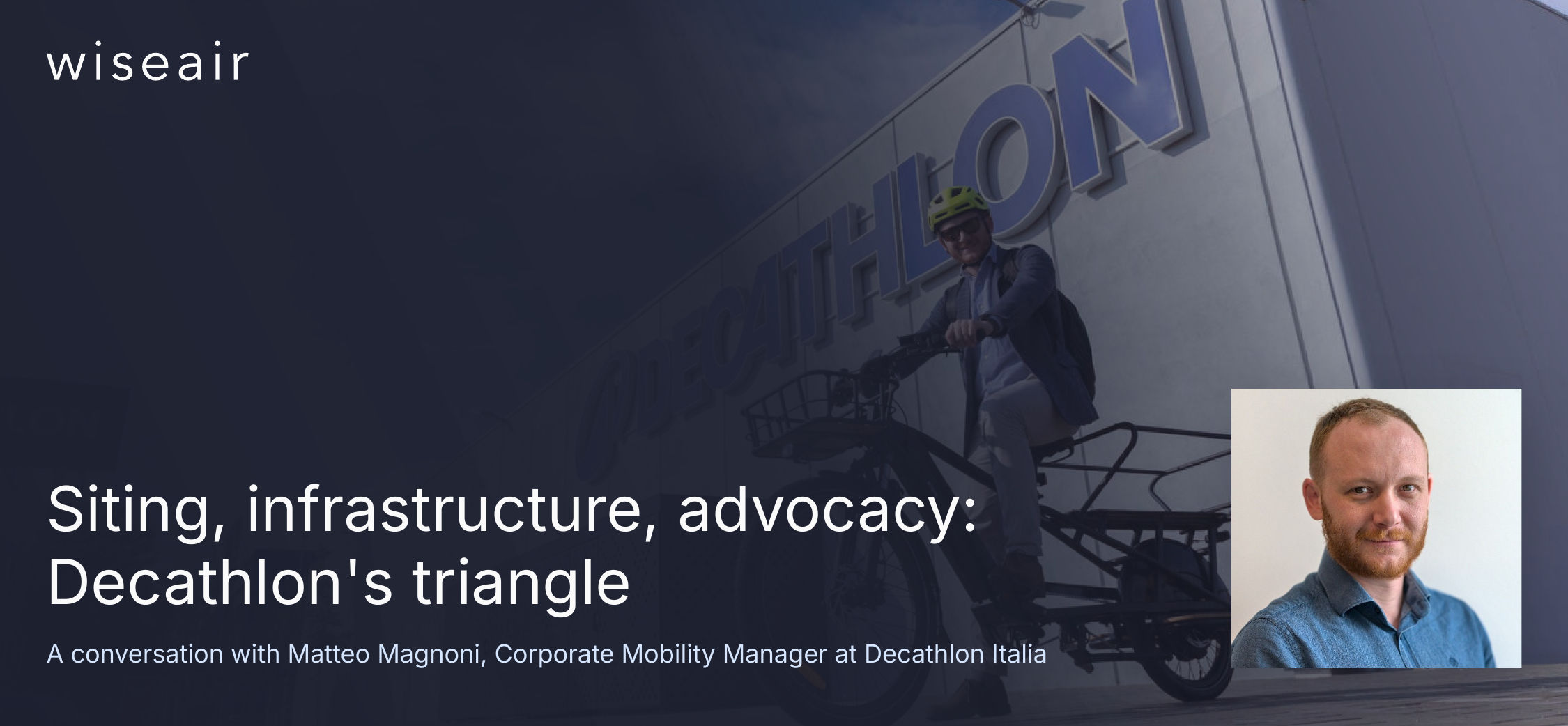
The travel of staff and customers accounts for 12.5% of Decathlon’s global emissions. It is an item that a company can act on with short-term operational tools. We spoke with Matteo Magnoni, Corporate Mobility Manager at Decathlon Italia, about how his company is using store location criteria, bike parking, and local advocacy to shift the balance from car commuting to active commuting.
Matteo Magnoni has worked at Decathlon for fifteen years and since 2024 has been Corporate Mobility Manager. His remit covers business travel, the corporate fleet, and employees’ daily commutes; in Italy he directly manages the Home-Work Commuting Plans (PSCL) of each production unit.
Paolo Barbato: Decathlon sells sport and movement. How much does this identity weigh on the way you built your role?
Matteo Magnoni: It weighs a lot, and it was the first argument I used when I started building my scope of work. Decathlon has a clear purpose: to unite through sport to make wellbeing accessible to all people. When you start from there, active mobility is not a topic on the side of corporate sustainability. It is the sector in which Decathlon competes every day as a provider of products and services, and bringing it into the company as a daily practice of collaborators is the most direct way to make it credible. It gave me a strong starting point: I did not have to convince anyone that the bicycle was a good idea in the abstract, because Decathlon has known it for fifty years.
Paolo Barbato: The travel of staff and customers accounts for 12.5% of Decathlon’s global emissions. Why focus precisely on this item?
Matteo Magnoni: Because at Decathlon it is one of the areas where we can activate operational levers and obtain results already in the short-to-medium term. Acting on commuting means working on choices of welfare, infrastructure, and incentives that can be implemented within one or two years. It is a question of pragmatism: we prefer immediate, concrete action to the mere analysis of percentages.
Paolo Barbato: You brought mobility management into real estate decisions. Explain that better to me.
Matteo Magnoni: At Decathlon we have defined location criteria that enter into the assessment of every new site: the presence of bike lanes within 150 meters and of public transport stops within 500 meters are assessment requirements, not optional elements. In parallel we are building a network of bike parking at headquarters and existing stores, with differentiated solutions: closed, secure boxes for collaborators, covered racks for customers. The logic is that infrastructure matters more than economic incentives: if you arrive by bicycle and have nowhere to leave it safely, no bonus will convince you to do it the next time.
Paolo Barbato: What arguments do you bring within the company to support these investments?
Matteo Magnoni: The direct comparison between the costs of the two modes is what works best. The estimated annual cost of someone who commutes to work by bicycle is around 300 euros; the average cost of owning and using a car in Italy weighted over the vehicle’s first 4 years of life, according to the Car Cost Index LeasePlan 2022, exceeds 12,000 euros. It is an economic argument that needs no translation. To this is added the macro level: according to the data collected by Colville-Andersen in Copenhagenize, for every kilometer traveled by car the national economy loses 89 cents (health costs, congestion, infrastructure, environmental externalities), while for every kilometer traveled by bicycle it gains 26. Addressing the topic on several levels allows Decathlon to build a proposal and, consequently, a decision that is more solid.
Paolo Barbato: Is there something that does not depend on the company and that makes the work more difficult?
Matteo Magnoni: The urban context. A company can do a lot internally, but if the streets around the site do not have safe cycling infrastructure, the barriers that hold people back remain outside our control. This is why at Decathlon we have chosen to invest also in external advocacy, working on three different fronts. In urban active mobility we took part in events such as MilleMila Bici Milano with Legambiente and Milano in Bicicletta and Siamo Nati per Camminare of the Genitori Antismog association. In institutional and research contexts we have spoken at the Camera dei Deputati for the Congresso Nazionale sullo Sviluppo Sostenibile dell’Appennino, at L’étape Parma, at Bocconi, at DIDACTA Firenze. In inclusion, with Vento in Faccia and Decathlon Foundation we work together with associations and bodies such as Il Germoglio, Rete Macramé, and TikiTaka to make active mobility accessible also to those who have physical or cognitive barriers. It is the attempt to contribute to building an environment more favorable to active mobility; without collective work the rest remains an exception instead of becoming the norm.
Not every company has the identity advantage of Decathlon, where active mobility is already part of the business. The method, however, is separable from the identity: defining measurable proximity criteria in real estate choices, building internal infrastructure before delivering incentives, articulating external advocacy on several levels.
These are three steps that any company with a structured mobility management function can begin to work on in its next annual planning cycle.
Corporate Mobility Manager at Decathlon Italia, where he has worked for fifteen years and has held this role since 2024. His remit covers business travel, the company fleet and employees' daily commutes; in Italy he directly manages the Home-Work Commuting Plans (PSCL) of every production unit.