
Thinking in networks: what Italy can learn from the Dutch cycling model


A conversation between Paolo Barbato and Chris Bruntlett, Dutch Cycling Embassy.
When it comes to cycling, Italy lags clearly behind the European average. According to the Eurobarometer 495 (2019), only 4% of people in Italy name the bicycle (or scooter) as their main mode of transport on a typical day, against an EU average of 8%, 15% in Germany, 21% in Sweden and 41% in the Netherlands. The figure is a few years old, but later surveys confirm the picture. The Copenhagenize Index 2025, produced by Copenhagenize for EIT Urban Mobility, assesses 100 cities across 44 countries on 13 indicators grouped into three pillars (safe and connected infrastructure, usage and reach, policy and support), and captures the Dutch primacy: Utrecht ranks first in the world, followed by Copenhagen, Ghent and Amsterdam. The index also measures recent momentum, and here a figure stands out for those starting from far behind: Paris rose from 5% to 11% in five years, the strongest growth recorded, proof that the gap can be closed quickly when investment is sustained.
The same gap shows up at the urban scale in the European Commission survey on the quality of life in European cities (2023). The chart below shows the share of residents who use the bike as a mode of transport on a typical day, city by city.
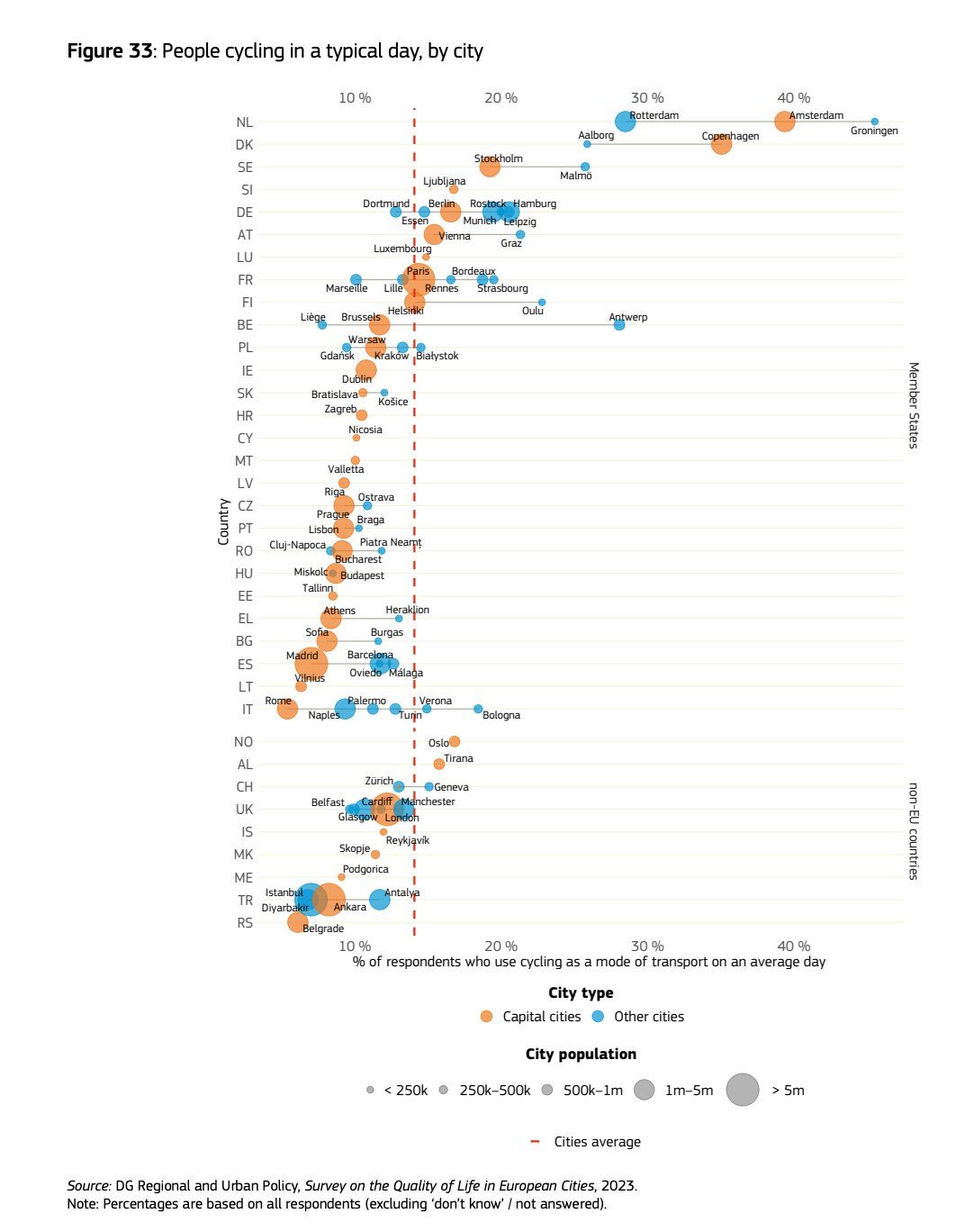
People cycling on a typical day, by city. Source: DG Regional and Urban Policy, Survey on the Quality of Life in European Cities, 2023.
The chart says three things. The Netherlands is the top row, the undisputed leader: Groningen at 46%, with Rotterdam, Amsterdam and Aalborg all above 30%. Italy sits at the bottom of the ranking by national average: Rome stops at 5%, and Naples and Palermo remain below the red line marking the average across the surveyed cities. But the same Italian row shows that some cities do better: Bologna sits clearly above the European average of the surveyed cities, and Verona reaches it, a sign that the lag is not a fate but a function of local choices.
These are numbers that tell of a lag, but also of room to grow. The question, then, is not whether Italy should close that gap, but how: with what infrastructure, in what order of priority, and with what role for those who are not a public administration but decide every day how thousands of employees move.
To bring Italian readers an expert perspective, we interviewed Chris Bruntlett, International Relations Manager at the Dutch Cycling Embassy. A Canadian from Vancouver, he has lived in Delft for almost a decade and travels constantly to bring Dutch cycling know-how to cities around the world. Together with Melissa Bruntlett, he is the author of Building the Cycling City: The Dutch Blueprint for Urban Vitality and Curbing Traffic: The Human Case for Fewer Cars in Our Lives. His is the view of someone who observes our cities from the outside, and who lives every day in a mobility system built on different assumptions. We publish this interview in a special edition of our newsletter “La Nona Ora” dedicated to World Bicycle Day on 3 June 2026, with the aim of offering local administrators, CEOs, urban planners and anyone who wants to promote cycling in Italy a concrete reference point and a set of already-proven best practices.
What an Italian no longer sees
PB: You have a Canadian background, you have lived in Delft for almost ten years and you travel constantly for work. When you arrive in an Italian city, what do you notice that an Italian no longer sees and that you spot right away?
Chris Bruntlett: The difference between stepping out of a Dutch train station and a station in an Italian city is enormous. To the point that most Italians don’t even process it. When you enter your city through what should be its gateway, you are met with a wall of cars. The noise, the pollution, the stress, the public space taken up by cars and taxis: all of this is detrimental to the experience of arriving. And then, walking through the streets, you notice how much public space cars take away: the streets, the squares.
This erodes the quality of life in the city. So much public space is taken up for a vehicle that sits idle 98% of its life. One of the reasons I chose to focus on mobility is precisely that it has an enormous and invisible impact on urban quality of life. It decides who can access public space: from children to the elderly, from women to people with disabilities. The car excludes many types of people and makes cities less interesting, less social and less green, also in the literal sense, because it prevents us from planting trees and vegetation.
What I see in Italy is a lot of possibility. If we start changing how people move, we can change the fabric of the city and the structure of the street, and make it a more livable, inclusive and prosperous place.
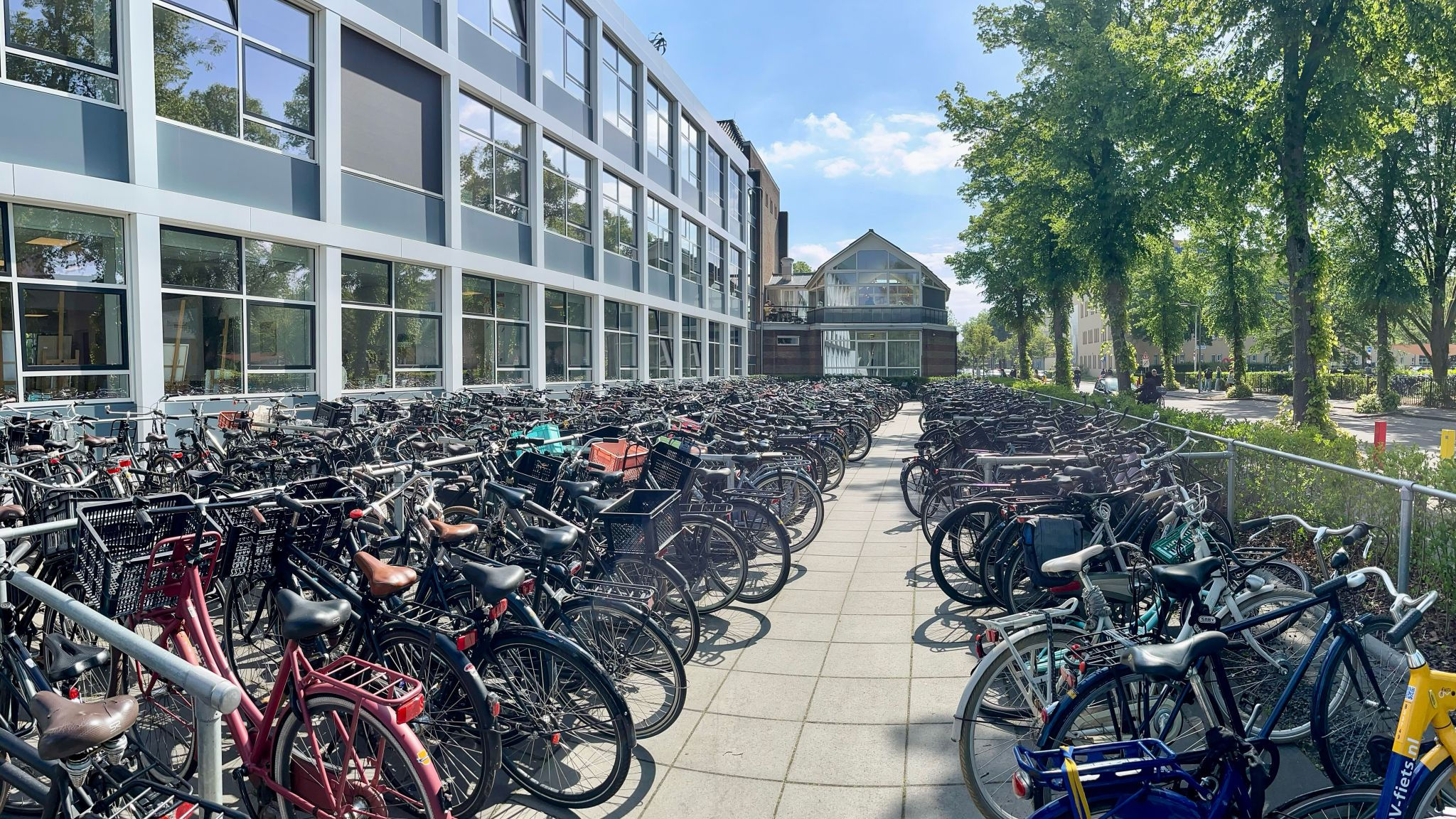
Students' bicycles outside St. Bonifatius College in Utrecht. Source: Dutch Cycling Embassy.
It’s not (only) about bike lanes
PB: In Italy the public debate on cycling often polarizes into a stark choice, bike lanes yes or bike lanes no, one lane at a time and one political battle at a time. You keep saying the Dutch model isn’t built that way. Are the lanes really the bottleneck?
Chris Bruntlett: The most effective approach is to build a network, and to build it as quickly as possible. It’s something Delft discovered in the 1970s. But it’s worth emphasizing that bike lanes alone do not make a network. There is the visible infrastructure, of course, on the main roads with shops, offices and housing. But there is also traffic calming, circulation, and the invisible infrastructure: the quieter side streets, the local-access streets that can form a significant part of the network. Here in the Netherlands up to two thirds of the network is in mixed, low-traffic conditions, where the bike is still the predominant mode.
We have to get out of the mindset that we need a fully segregated lane on every single street. We need a more holistic approach, made of carrot and stick: the carrot is the beautiful separated bike lane, the stick is restricting through traffic, making it slower and less direct, filtering out unnecessary traffic in residential and commercial areas, so that walking, cycling and even playing in those streets becomes comfortable.
PB: And on the political level, what enables the speed with which you say the network should be built? I’m thinking of an Italian city setting itself long-horizon plans, like the Biciplan of Rome, which aims for over 1,500 km of bike lanes by 2035.
Chris Bruntlett: On the political level, it’s almost more advantageous to do it fast. You don’t drag out the pain by doing it in slow motion, one street at a time, taking the backlash over and over again. Cities like Seville, like Calgary in Canada, built their network almost overnight, in 12-18 months. Concentrate the backlash, get it over with as quickly as possible. You’ll see a spike in usage as a result, because the network effect is such that people only start using it once it connects where they are and where they want to go. If you build one street, one corridor at a time, you severely limit your user base.
The biggest mistake a city can make is building one corridor at a time. Cycling works when it connects the home to the school, the doctor, the restaurants, the shops, and everything in between.
PB: So the advice is not to spread the backlash over time, but to concentrate it, while activating the network effect at the same time. In Italy something similar was done in Bologna with “Città 30”, the lowering of speed limits, managed as a coherent campaign rather than closing one street after another. Is that a model closer to Italian municipalities?
Chris Bruntlett: Exactly. And beyond the infrastructure, the ultimate goal is to make cycling safe and convenient. Infrastructure is just a way to get there. Mixed-traffic streets are less visible, but in many cities they are more effective.
The role of companies: incentives, collaboration, infrastructure
PB: Let’s move from the perspective of the public administrator to that of businesses. In Italy, thanks to recent legislation, companies have begun to tackle their employees’ home-to-work mobility through the Piano Spostamenti Casa-Lavoro (PSCL), the workplace commuting plan. What concrete tools do Dutch companies have to encourage active mobility among employees?
Chris Bruntlett: There are various incentives and supports they can offer employees. Here in the Netherlands many companies offer a public transport card that covers tram, bus, train and the shared OV-fiets bikes for work travel, including the commute to and from the office. It helps intermodality a great deal. Then there are plans that, through tax breaks, incentives and discounts, allow employees to lease a bike or an e-bike, or to claim a per-kilometre reimbursement for work travel, including commuting. It is not a payment from the state to the cyclist: it is a benefit the state grants to employers, who can pay that reimbursement tax-free up to a cap, today around 23 cents per kilometre.
And if we think about the trip to school, that is a huge burden on parents. The sooner we can enable children’s independent mobility to get to school without mum or dad escorting them, the sooner we remove a cost of time and stress in the morning and the afternoon. The biggest opportunity, with small initiatives, is to support the travel patterns people already follow. We just need to make them easier.
PB: In Italy we say that encouraging cycling where it isn’t safe to cycle is not a responsible thing to do: it’s hard to push someone onto a bike if the infrastructure isn’t there. That’s why we suggest companies think long-term and become advocates for safe infrastructure where it’s missing. Have you seen Dutch companies collaborate with municipalities to build infrastructure or policies for active mobility, or is it a separate game in which the company steps in only once everything is already in place?
Chris Bruntlett: A very good example is a bridge built in Utrecht in 2017, for walking and cycling, over the train tracks. About two thirds of the budget was paid by Rabobank, the large Dutch bank, because it gave its employees a direct walking and cycling connection to the city centre from their offices. They weren’t doing it out of kindness or as a form of philanthropy. It was a direct investment in the health and wellbeing of employees, who wanted to walk to the centre for a sandwich at lunchtime, or for their commute to and from the office. It gave them a safer, more direct alternative to going almost a kilometre around the tracks.
Against a total cost of about 15 million euros, the bank donated more than 9, for both design and construction. It’s in the centre of Utrecht, and on any day of the week it is crossed by thousands of people.
E-bikes as range extenders
PB: In Italy e-bikes are still associated with delivery riders, and they aren’t perceived as a safe way to cycle. You call them “range extenders”. How do they fit into the future of urban and intermodal mobility?
Chris Bruntlett: It’s counterintuitive, but in per-capita terms the Netherlands has embraced the e-bike more than any country in the world. E-bikes are now a third of all bikes: 8 million out of 24. And this despite being a small, flat country where many people already cycle. The drivers were good infrastructure and good parking, and it brought new people into cycling, particularly older people and women. It also extended cycling’s range: the average e-bike trip is double that of a regular bike.
E-bikes have outsold traditional bikes for about five years now, and that will only continue. We no longer talk about cycling just within the city, but between cities, connecting villages and towns through the long-distance cycle highways being built. Routes of 15-20 km, which generate a lot of congestion: too long for a regular bike or a bus, too short for the train.
Outside the Netherlands you always hear the same objections: too hilly, too spread out, too hot. The e-bike removes all those excuses.
We don’t talk enough about the cost of owning a car: it easily exceeds 10,000 euros a year between maintenance, depreciation, fuel and parking. The more we give people access to low-cost intermodal transport, the more we improve their quality of life and reduce that financial burden.
The mobility of care
PB: Before wrapping up, I’d like to return to a point that directly concerns those who draw up corporate plans. When companies talk about employee mobility, they almost always think only of the home-to-office trip. In a single day, though, parents take their children to school, do the grocery shopping, go to the doctor, care for an elderly relative. All of this remains invisible to those who draw up the plans, and it falls disproportionately on women. What does it mean to design a strategy that accounts for the employee’s whole life, and not just the commute?
Chris Bruntlett: Without exaggeration, this is the biggest blind spot in the entire transport sector, and also the biggest opportunity for change. We have built entire transport systems and entire cities around making the single, long-distance, single-purpose commute from home to office as smooth and efficient as possible for the family’s ‘economic breadwinner.’ In doing so, we have largely ignored the reality of the ‘mobility of care’: the multiple shorter, multi-purpose trips that caregivers, still disproportionately women, make before and after paid work.
Instead of a linear pattern, it’s a spiderweb pattern. It can be greatly facilitated by good walking, cycling and public transport networks, and by intermodality that is as seamless as possible between those networks. The point is that we aren’t even measuring those trips, let alone designing for them. Much of the data we publish concerns only the home-to-work commute, which is a minority fraction of all the trips we make in a day. We forget all the others. Trips that are often easier to convert to other modes, because they are closer to home.
A message to decision-makers
PB: If you had to leave a single message to an Italian CEO who should give more weight to mobility in their company’s policies, why should they do it?
Chris Bruntlett: In the end, it’s good for your bottom line. It translates into more productive, healthier employees, and less money spent on parking. It saves companies money and it saves people money. And that money we can invest in more enjoyable and important things, rather than in our travel. Today transport is an enormous financial burden. And ultimately, giving people the ability to choose offers them far more opportunity and freedom.
The point Bruntlett makes most forcefully is a correction of method. For years, in Italy, we have built cycling infrastructure in segments, accumulating lanes that don’t talk to each other. The Dutch lesson reverses the order: the network first, then the individual stretch. And the network is not made only of protected lanes, but also of slow, mixed-traffic streets, which cost less and cover up to two thirds of bike trips.
For the business world, his observation on the mobility of care touches exactly the limit of how PSCL data is read today. The home-to-work commute is only a part of daily trips, and a plan that looks only at commuting ignores the most unequal share of employees’ real mobility. The example of the Rabobank bridge in Utrecht (the Moreelsebrug) shows a third way, between passively waiting for public infrastructure and its absence: a company that co-finances a connection because it measures the return in health and productivity.
3 June is World Bicycle Day. Italy starts from a 4% modal share against the European 8%, but the lag can also be read as room to work. For those involved in mobility in Italy, from the local administrator to the CEO, Bruntlett’s lesson shifts the question from “how many kilometres of lane” to “which network, built in how much time, serving which trips”.
Chris Bruntlett
Chris Bruntlett is International Relations Manager at the Dutch Cycling Embassy, a public-private partnership that represents Dutch knowledge and experts in the field of cycling. Originally from Vancouver, he lives in Delft. He is the co-author, with Melissa Bruntlett, of Building the Cycling City: The Dutch Blueprint for Urban Vitality and Curbing Traffic: The Human Case for Fewer Cars in Our Lives.
International Relations Manager at the Dutch Cycling Embassy, a public-private partnership that represents Dutch knowledge and experts in the field of cycling. Originally from Vancouver, he lives in Delft. He is the co-author, with Melissa Bruntlett, of Building the Cycling City: The Dutch Blueprint for Urban Vitality and Curbing Traffic: The Human Case for Fewer Cars in Our Lives.