
Who moves, who pays, who decides. Mimi Sheller on mobility justice in the age of data and AI

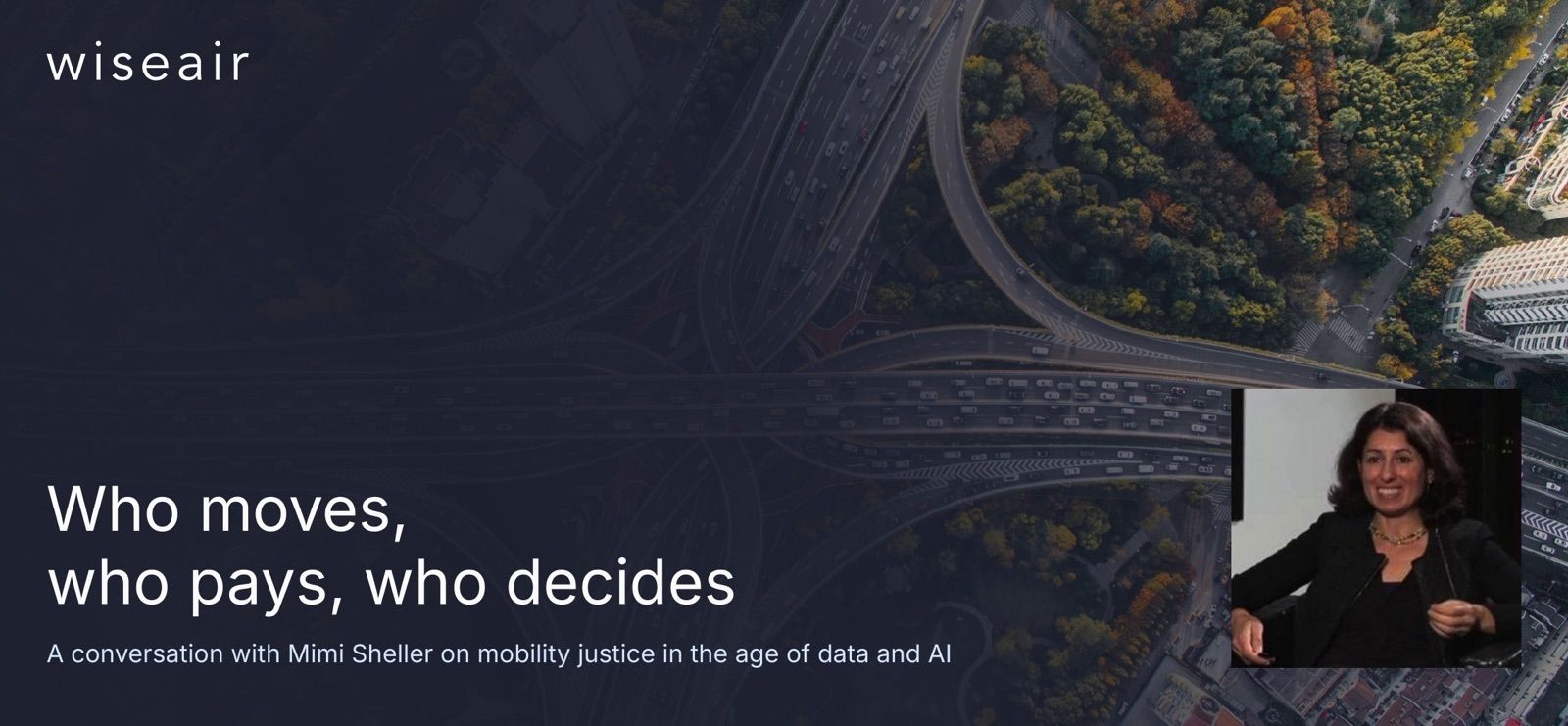
A conversation with Mimi Sheller, Professor of Integrative and Global Studies and former Dean of The Global School at Worcester Polytechnic Institute.
Mimi Sheller is one of the scholars who shaped the new mobilities paradigm. She was a founding co-editor of the journal Mobilities and is the author of Mobility Justice: The Politics of Movement in an Age of Extremes. We met her in Milan on 6 November 2026, when she opened the welcome day of the URBEUR PhD programme at the University of Milano-Bicocca with a lecture on mobility and data justice in the age of artificial intelligence, discussed by Paola Pucci (Politecnico di Milano) and Gabriele Grea (Bocconi University).
Her work asks questions that rarely appear in transport plans. Who benefits from a mobility system, who bears its costs, and who gets to decide? Today the same questions apply to the data that every journey now produces, and to the algorithms that increasingly steer how we move.
Interview by Paolo Barbato with Mimi Sheller.
Paolo Barbato: Let us start from the concept that gives the title to your book. What is mobility justice, and how is it different from the way planners usually look at transport inequalities?
Mimi Sheller: Mobility justice is a way of thinking about transport injustices, inequalities and social exclusion within a broader theoretical perspective. Its starting point is that power and inequality are embedded in the governance and control of all forms of mobility and immobility, of moving and of dwelling. Uneven access to mobility space is built into the way our cities and our transport systems work. It is not a glitch, it is a feature.
Control over mobility has deep historical roots, in patriarchy, colonialism, imperialism and racial capitalism. These differential mobilities are performative. They are scripted into our spatial relations and practices, and they reinforce gender, racial and ethnic differences, as well as differences of ability, because space creates physical barriers of different kinds for different people.
So who is able to put the potential for mobility into action is both a political and an ethical question. Political, because it concerns which rights to mobility exist and how they are exercised and protected. Ethical, because it concerns which capabilities for movement a society values, defends and extends to everyone. A right may exist on paper, but who is actually protected, who feels safe, who feels empowered to use those spaces of opportunity? That is why my approach does not begin from trains, buses and cars as such.
Paolo Barbato: Your work moves across very different scales, from the body to the planet. Why is that necessary?
Mimi Sheller: Because the scales are entangled. There is the scale of the body, with our personal capabilities, disabilities and access. There is the scale of transport systems and of urban infrastructure, how it is envisioned, planned, built and resourced. There is the transnational scale of borders and migration, which is closely linked to who has access to urban space. And there is a planetary scale. To build our mobility systems we need metals, energy, fossil fuels and cement, and burning fossil fuels changes the climate, which in turn affects people’s mobility.
Transport, from automobility and cycling to public transit, micromobility and aviation, is one scale within this picture. Looking at transport alone, we miss how it is connected to everything else.
Paolo Barbato: How does this translate into concrete questions for transport planning?
Mimi Sheller: I would give a few examples. The first is a city where you have no choice but to move by car. As driving becomes more expensive, a big inequality is built into that dependence. The second is a highway project that divides a community. In the United States, highways cut across neighbourhoods with the least political power, especially African-American neighbourhoods, and left them fragmented. The third is a major transport improvement that concentrates benefits in already advantaged areas, while peripheral and rural communities are left further behind as services and businesses move along the new corridor.
In all these cases the question is not only who can move more quickly. We need to ask who benefits, who pays the costs, who gets to make the decisions and who is excluded. That is a good summary of how we try to bring mobility justice into transport planning.
Paolo Barbato: The energy transition is often presented as a technological shift, with electric cars replacing combustion engines. What does a mobility justice lens add?
Mimi Sheller: Transport accounts for close to 30% of greenhouse gas emissions, both in the European Union and in the United States, so electrification matters. But green deal policies did not always consider the resource intensity of replacing the entire vehicle fleet with electric cars. That would require a huge amount of planetary resources, and its impacts would be externalised onto the places where mining happens and where electricity is generated. This is also linked to climate mobilities, people displaced by climate change and by resource extraction, often in other parts of the world, to support the energy transition of the Global North.
There is a second problem. We cannot impose decarbonisation evenly on everyone. When everyday life becomes too expensive, when people in rural areas cannot move around, when working-class people feel hurt by these policies, we see strong movements against the transition. A recent collective book, published in French by the Forum Vies Mobiles as Déviation and in English as Navigating Detours in the Mobility Transition, argues that we should concentrate on those with the greatest impact. If we can cap the energy consumption and the mobility excesses of the wealthiest 10%, we can bring emissions down significantly and have a more sustainable and just transition.
Paolo Barbato: In the second part of your lecture you introduced the idea of mobility data justice. Why do we need it?
Mimi Sheller: Mobility data justice is a framework I have developed together with Frauke Behrendt, of Eindhoven University of Technology, bringing together questions of mobility justice and data justice. Being mobile today means producing data, consciously or not, from many different sources. Our mobile phones, ride-sharing apps, car sensors, car insurance apps that rate our driving, ticketing apps for public transport, the geofencing of bike and scooter sharing, navigation and GPS, fitness devices that record our steps and heartbeat, traffic lights and car parks connected to the Internet of Things. All this data is collected from whoever moves through this technological infrastructure.
Last year I visited the city control centre in Seoul, in an underground bunker with a huge wall of screens. Public transport, CCTV cameras, taxis and ride-hailing services all fed live data into it, and the data was precise enough to show how women and men were moving, with the click of a button. It was built for emergency management, but the level of surveillance was incredible.
This datafication is now central to the governance of movement, and therefore to the production of unequal mobilities. Mobility depends not only on the design of the built environment but also on informational design. Planners, technologists, designers and regulators need a framework to ask whose movement is captured, which movements are overlooked, and who controls the data.
Paolo Barbato: You propose four dimensions of justice to read these systems. Can you walk us through them?
Mimi Sheller: Distributive justice asks how access to mobility and to data is unequally distributed, who benefits and who is harmed. Frauke’s work on food delivery riders in Seoul, for example, shows how gig economy algorithms push workers to go faster and to use unsafe routes, because the algorithm monitors everybody’s speed and sets the expected pace.
Procedural justice asks who designs and controls mobility data infrastructures, and what role public institutions, private companies and governance processes play in decisions that are now bound up with algorithms.
Epistemic justice is about what counts as mobility knowledge. What is quantified, who quantifies it, and what is left out? Transport planning has often ignored qualitative, embodied knowledge. There may be a transit stop on your block, but you may not be able to reach it. In Bangladesh, electric rickshaws count as electricity customers but not as electric vehicles, and that gap has consequences for decisions.
Reparative justice asks who has already been harmed by or excluded from existing mobility systems, and whether new automated mobilities will make those harms worse or help repair them.
Paolo Barbato: Automation is the next frontier. What changes when vehicles start driving themselves?
Mimi Sheller: If we think of the street as a commons, automobility had already taken much of it away from other uses. Automated mobility risks enclosing it further, into business models owned by a few technology companies. Robotaxis such as Waymo, which were attacked during protests in Los Angeles in June 2025, have become a focus of conflict precisely because people connect them with job losses, safety concerns and surveillance.
There is also the problem of black boxing. We do not understand how AI systems reach their decisions, and that undermines the very idea of procedural justice. Automated taxis have stopped in flooded streets with passengers inside, or gathered in a dead-end street, and nobody could explain why. And there is a deeper question. When we train automated vehicles to protect people, who is not being considered a full person? How might existing inequalities leave some people out of the calculations of the machines?
Paolo Barbato: At Wiseair we work with companies and their mobility managers on home-to-work travel plans, and every plan produces data on how thousands of employees commute. From your perspective, how can this kind of data help build fairer mobility instead of becoming one more layer of extraction? And where do you see the most promising alternatives taking shape?
Mimi Sheller: I would start from the principles that the literature on data justice already offers. Be transparent about what data is collected and for what purpose, give people real choices to opt in or out, prefer open to proprietary platforms, and keep the public interest in view. These principles become harder to apply as systems grow more automated and algorithmic, which is why it matters to build them in from the start. Open data alone is not enough, because data can also be misused, so there has to be some form of accountability towards the people who produce it.
Then I would look at where innovation actually comes from. In Chicago, an organisation called Equiticity grew out of community bike rides that promoted racial equity and the right to the street. It now promotes neighbourhood hubs, places that bring people together and give access to shared mobility, electric bikes, public transit, charging, information, services and community events. They are working with the city and the State of Illinois to invest first in neighbourhoods with low mobility. If we begin from the places with the least access and invest there first, we get a different idea of innovation.
I think of this as a commoning of accessibility. Commons take different forms, from subsidised public transport, a kind of state commons, to cooperatives and the informal sharing practices I call the undercommons. Public authorities can help bring these models into cooperation and support bottom-up processes without privatising or absorbing them, starting from the mobilities of care that matter so much in everyday life. And whenever I hear about value creation, I ask which values we value. If we value social and collective values, creating value means something very different from a new model of extraction.
Professor of Integrative and Global Studies and former Dean of The Global School at Worcester Polytechnic Institute. She is one of the scholars who shaped the new mobilities paradigm: she was a founding co-editor of the journal Mobilities and is the author of Mobility Justice: The Politics of Movement in an Age of Extremes.