
Decoding modal shift: why is it so hard to get people out of their cars?

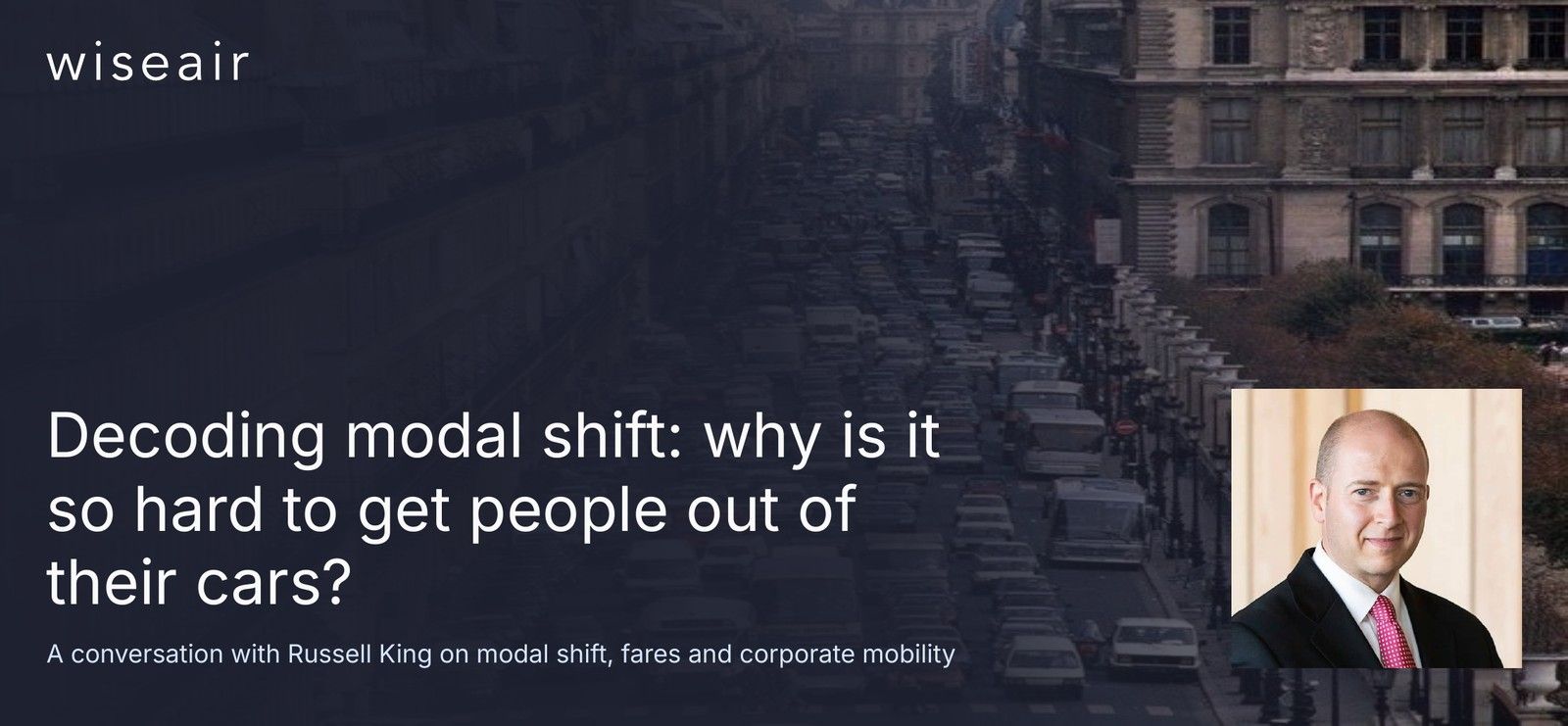
A conversation with Russell King, a transport policy expert and author of the Transport Leader newsletter.
Interview by Paolo Barbato with Russell King.
Building fast, frequent and reliable public transport seems the obvious recipe for convincing people to leave their cars behind. The data tell a more complicated story. On the new metro lines in London and Sydney, celebrated as successes with passenger numbers beyond forecasts, most of the new users came from other public transport, not from cars. In Riyadh, by contrast, the shift to the car was massive, but not because the metro was exceptional: driving was already so inconvenient that the bar to clear was low. The same intervention produces opposite outcomes depending on how desirable the car is at the starting point.
For those who manage corporate mobility, the issue is not academic. The Mobility Manager does not build metros or impose tolls, but governs a set of choices that shift the desirability of the car for their employees every day: where the site is located, how much parking costs, how mobility benefits are treated for tax purposes. It is the side of the equation over which a company has more control than it imagines.
Russell King has worked for almost twenty years on transport policy at an international level, with experience ranging from metros, railways and trams to buses, BRT, active mobility and emerging services such as car sharing, and on reforms ranging from parking policies to fare structures. He is the author of the Transport Leader newsletter, which brings together more than 3,000 professionals, consultants, academics and transport experts. What follows is the thread of the conversation.
The core misunderstanding: what public transport competes against
Paolo Barbato: What do we get wrong about getting people to switch to public transport?
Russell King: There is a widely held belief that if we improve public transport (fast, frequent and reliable) or make it cheap enough, or even free, people will give up their cars and switch to buses, trains and light rail.
Unfortunately, it is not that simple. Even when we build amazing, well-patronised metro lines, such as the Elizabeth Line in London or Sydney’s Metro, there is a belief that people gave up their cars in favour of the metro. However, the evidence shows that this is not the case. The vast majority of people using these new lines were people already using public transport, either buses or other train lines.
This misconception occurs because we forget what public transport is competing against - the car. If we make the car cheap and very convenient (such as by providing free parking), then improved public transport can close the gap on the car, but it rarely makes it more appealing than the car.
This is not just a service problem. It is also an economic one. When we calculate what drivers actually pay (fuel taxes, registration, purchase taxes) against the full cost of the road system, we leave out a long list of hidden subsidies: free or underpriced parking, the health costs of crashes and pollution, emergency services, and the land value consumed by road infrastructure. International research consistently shows drivers cover only around half the true cost of driving.
In effect, we are subsidising driving, which increases the amount people drive, creating congestion. Rather than tackle the underlying problem of car subsidies, we choose to increase subsidies on public transport in a futile attempt to reduce congestion. Taxpayers end up paying twice: once to subsidise car use, and again to subsidise public transport to compensate for it.
We will never be really successful at getting people out of their cars and tackling congestion until we address the car subsidy problem.
Free fares: who really benefits
Paolo Barbato: How do low or free fares help?
Russell King: Very low or free fares have become very popular around the world. The logic is that if public transport is made cheap enough, people will give up their cars and use it more. The other argument is often an equity one (people on low incomes don’t drive, and public transport fares discourage their mobility) or a cost-of-living argument.
Unfortunately, the evidence doesn’t support any of these arguments.
Low or free fares do increase public transport patronage. But the new passengers are not mainly people who left their cars. Research consistently shows that they are people making trips they wouldn’t otherwise have made, or people who switched from walking and cycling.
The equity argument doesn’t hold up very well either. Many of the people who benefit most from fare reductions are relatively wealthy commuters with good access to frequent services. People on low incomes are more likely to live in areas with poor or non-existent public transport, often with no viable alternative to car ownership, which costs them thousands of Euros a year regardless of what fares do. A blanket fare reduction gives them nothing. Targeted investment in extending and improving services in underserved areas would do far more for transport equity than making existing services cheaper for people who already use them.
On the cost of living, the evidence from recent fuel price spikes is instructive. When petrol became significantly more expensive, people did switch from cars to public transport to save money, but this happened largely regardless of whether fares were free or reduced. Price signals on the car side moved behaviour. Signals on the public transport side were largely irrelevant.
There is also a longer-term problem. Free or heavily discounted fares have to be paid for, and the money typically comes from existing transport budgets. That means less investment in service expansion, less maintenance, and, over time, declining reliability. The consequence is a gradual deterioration in the customer experience, which drives people back to their cars. A policy sold as improving public transport can end up weakening it.
The proper place for equity and cost-of-living issues is to address the economic, tax, and welfare systems that are the real source of the problem.
In short, free fares are not a good answer to improving transport, equity or the cost of living.
Cycling and the political barrier of infrastructure
Paolo Barbato: What about encouraging cycling?
Russell King: Cycling is one of the most space-efficient modes of transport we have. A single lane of cycling infrastructure can move far more people per hour than the same lane dedicated to cars. Add the health benefits, the near-zero emissions, and the negligible road wear, and the case for cycling as a serious transport mode is strong.
E-bikes could significantly improve the calculus. Early lending schemes and purchase subsidy programmes have produced something relatively rare in transport policy: evidence of genuine car trip replacement. E-bike interventions appear actually to pull people out of cars.
But cycling faces a structural problem. The infrastructure required to make it work for a mass audience is also the infrastructure most likely to generate political resistance.
Most people will not cycle in traffic. Subjective safety is the primary barrier and requires physical separation from motor vehicles. But building segregated lanes typically means reallocating road space away from cars. Although the evidence shows that, after a settling-down period, this does not increase congestion, it still triggers predictable opposition from drivers, local businesses, and elected officials.
In the case of businesses, the opposition is often based on a misconception. Shop owners consistently believe that most of their customers arrive by car and that removing parking or traffic lanes will reduce trade. However, pedestrianised and cycling-friendly streets typically see increased footfall and higher retail spending because more people move through the space more comfortably, and the environment becomes a place people want to spend time.
Cycling is a significantly underused solution to our traffic problems, but we need to overcome the political barriers.
Carpooling: a niche solution and its limits
Paolo Barbato: How does this approach apply to carpooling?
Russell King: Carpooling has an intuitive appeal. The average car on the road carries around 1.3 people. If that figure rose to even 2, the number of vehicles in circulation would drop significantly, with meaningful benefits for congestion, emissions, and road wear.
However, there is a problem. People are reluctant to share a confined space with strangers.
Where carpooling does work, it tends to rely on pre-existing social infrastructure. Colleagues at the same workplace, students at the same campus, or residents of the same community. These contexts lower the social friction because the relationship already exists. The matching problem becomes easier when origin, destination, and timing are already partially aligned by shared circumstances.
Carpooling also has unintended consequences. For example, if, rather than people carpooling from 2 cars to 1, one of the carpoolers uses public transport instead, no car is removed from the road, and ridership on public transport declines.
Carpooling is not a bad idea. But it is usually a niche solution that works in specific contexts.
What a company can really do
Paolo Barbato: How do company employee policies help or hinder getting people to give up their cars?
Russell King: Companies have more influence over how their employees travel than most of them realise.
The starting point is understanding the problem before trying to solve it. That means mapping staff travel patterns: where employees live, what public transport options realistically exist for them, and what the company itself is currently doing to make driving the default.
Location is the most consequential decision, and the hardest to reverse. An employer that locates its premises away from rail corridors or frequent bus routes has already determined that most staff will drive.
Parking is the most direct lever available to companies. Free or heavily subsidised parking is a standing incentive to drive, one that companies pay for, whether they think of it that way or not, through land costs and foregone returns on capital. Charging for parking at a rate that reflects the true cost to the business changes the calculus for employees. Reducing the total supply of parking achieves the same outcome.
Tax treatment of company cars is a subsidy that many companies provide. Allowing employees to access a car through pre-tax income significantly reduces its effective cost, whereas equivalent treatment is rarely extended to public transport passes, cycling equipment, or e-bike purchase schemes. Rebalancing these benefits so they are mode-neutral, or actively favouring lower-carbon options, sends a very different signal.
Infrastructure advocacy and workplace facilities can be meaningful. Companies that depend on good public transport or cycling connections have a legitimate interest in lobbying for them. Providing end-of-trip facilities for cyclists removes a practical barrier that stops people who are otherwise willing to cycle.
Carpooling schemes are another tool some companies have experimented with. Employer-facilitated matching, preferential parking for carpoolers, and guaranteed ride-home schemes for emergencies can all reduce the friction that causes informal carpooling arrangements to break down. The important caveat, however, is that the source of new carpoolers matters. Company carpooling programmes work best when they are explicitly targeted at employees who live in locations poorly served by public transport and who would otherwise drive alone.
Direct incentives to switch are the most innovative frontier, and the evidence is still developing. Options include paying employees to relinquish parking permits, negotiating cross-company discounts on products or services for employees who commit to car-free commuting, and, in jurisdictions where carbon markets allow it, monetising the emissions reductions from mode shift and sharing the proceeds with participating employees.
Companies are not neutral actors in their employees’ travel choices. They shape those choices constantly, through location decisions, parking provision, tax benefits, and workplace culture.
Russell King
Russell King is a transport policy expert with almost twenty years of international experience across metros, railways, trams, buses, BRT, active mobility and shared mobility, and on reforms ranging from parking policies to fare structures. He is the author of the Transport Leader newsletter, followed by more than 3,000 professionals, consultants, academics and experts in the sector.
Russell King is a transport policy expert with almost twenty years of international experience across metros, railways, trams, buses, BRT, active mobility and shared mobility, and on reforms ranging from parking policies to fare structures. He is the author of the Transport Leader newsletter, followed by more than 3,000 professionals, consultants, academics and experts in the sector.