
The invisible commuter: transport poverty and home-work mobility

Transport poverty and home-work mobility: what a Mobility Manager needs to know.
A conversation by Paolo Barbato with Sofia Asperti, Project Manager Mobility Data at the Fondazione per lo Sviluppo Sostenibile (Foundation for Sustainable Development).
In Italy, according to the first Green Paper on transport poverty presented on 30 March 2026 by the Transport Poverty Lab, more than 7 million people live in conditions of transport poverty. Around 1.2 million households are at the same time at risk of poverty and bear particularly high mobility costs. 7.3 million citizens live in areas with insufficient public transport supply. The territorial divide is stark: in some areas of Sardinia and Sicily, supply drops below 200 seat-kilometres per inhabitant, against a national average of 4,623 and over 16,000 seat-kilometres in Milan.
These are figures that capture a phenomenon which until now had no national map. Energy poverty entered the public debate years ago, food poverty is monitored systematically. Transport poverty, on the other hand, has long remained off the radar of Italian social policies, despite affecting a significant share of the working population.
For those who manage employee mobility, these statistics are not policy background. They are the actual composition of the workforce that tries to reach the workplace every morning. The PSCL (Piano Spostamenti Casa-Lavoro — Home-Work Travel Plan) is today the most structured tool that Italian companies have to observe how their employees move. The question I’m interested in is what changes in that tool if it is read through this lens as well.
To try to answer, I met with Sofia Asperti, researcher at the Fondazione per lo Sviluppo Sostenibile and one of the authors of the Green Paper. Not to summarise the document — which is public and deserves a full read — but to understand where transport poverty meets the perimeter of corporate mobility management.
Definition
Paolo Barbato: The term “transport poverty” sounds distant from the corporate world. Where do you start to understand what it is about?
Sofia Asperti: The European definition is precise: it is the difficulty of bearing mobility costs or accessing the transport needed to reach essential services and activities. Work is among these activities. Read this way, the link with the company becomes immediate: a worker who cannot reach the workplace in a sustainable way, economically or geographically, is a vulnerable worker. And this vulnerability has costs that fall on the organisation too.
The data
Paolo Barbato: You analysed commuting data. What emerges for those who work?
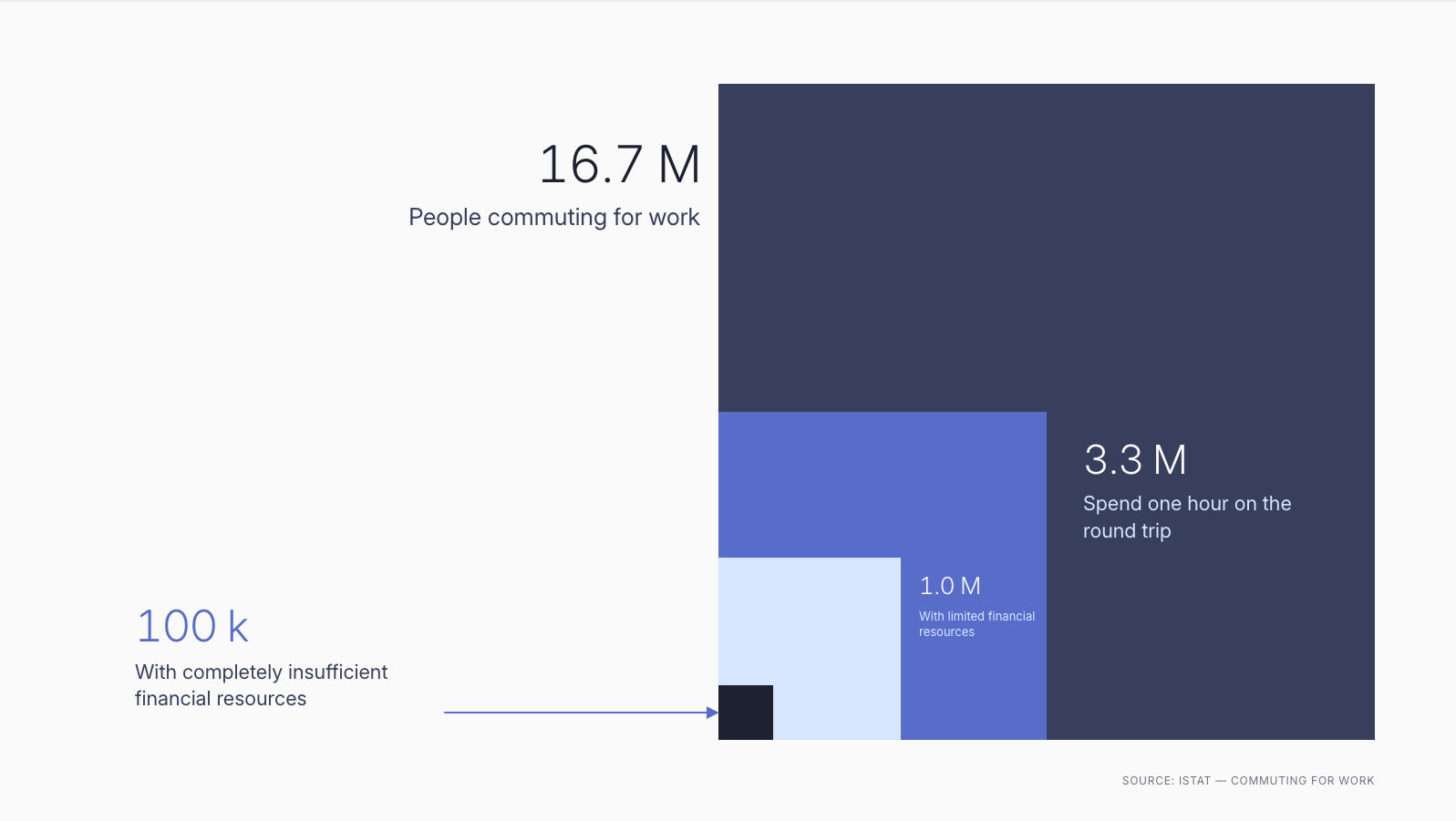
Sofia Asperti: Out of 16.7 million workers in Italy, almost 20% exceed 60 minutes of daily round-trip travel time. Among them, almost a third have scarce or insufficient economic resources. This means that for a significant share of workers, long travel time is not a choice: it is the result of compounding economic and territorial constraints. People don’t live far away because they prefer to: often they live where they can afford to.
The role of the company
Paolo Barbato: What role can a company play in this picture?
Sofia Asperti: A concrete role, more than one might think. The PSCL (the Piano Spostamenti Casa-Lavoro) is not just a regulatory requirement: it is an analytical tool that allows the company to understand how its employees move, where they live, how much time they spend and by which means. This snapshot is already a first step toward identifying the most difficult situations and designing targeted responses. The problem is that in most cases this potential remains untapped.
The tools
Paolo Barbato: In the document you cite vouchers, mobility wallets and home-work programmes as effective measures. Why these levers in particular?
Sofia Asperti: In the Green Paper we cite the tools mentioned in the context of public policy because they combine selectivity and flexibility, allowing them to be calibrated to local conditions. These are levers that make it possible to support the mobility demand of the most vulnerable groups in the population according to their specific needs. In this sense, home-work programmes represent a valuable instrument for improving the selectivity of measures, because they allow workers’ mobility needs to be identified more precisely.
The message
Paolo Barbato: A message for the Mobility Managers reading us?
Sofia Asperti: That their work is not limited to compliance. The data they collect, the analyses they carry out, the solutions they propose have an impact on people’s quality of life and on their ability to access work. This is not a second-tier issue compared to emissions reduction: equity and sustainability are two sides of the same transition.
What I take away from this conversation
Sofia’s point on the selectivity of measures resonates with something Matteo Colleoni told me in an earlier conversation: the Mobility Manager should design positively discriminatory interventions, differentiated according to real needs, rather than blanket policies. Transport poverty loads that principle with an additional meaning: blanket policies are not just less efficient, they risk leaving behind precisely the most vulnerable workers.
From here come two practical consequences for those working on PSCLs. The first is methodological: to talk about equity you need distributions, not averages. Home-work distances, times and costs must be read in their internal variability across the workforce. The second is about the horizon: the Social Climate Fund (86.7 billion total for 2026-2032, of which around 7 allocated to Italy) and ETS2, the European system that from 2027 extends CO2 pricing to road transport fuels and heating fuels, operate in the same period. Transition measures can amplify pre-existing fragilities if not accompanied by compensation policies. Reaching that deadline with structured data on one’s own employees makes the difference.
Sofia’s sentence that stays with me is the one about the geography of housing: people don’t live far away because they prefer to, they live where they can afford to. The home-work distance in corporate datasets looks like just another variable. It is instead the reflection of a real estate market: it tells you how much the worker can spend to live nearby, not how much they want to.
Sofia Asperti
Project Manager Mobility Data at the Fondazione per lo Sviluppo Sostenibile, where she works on the analysis of transport and energy data in the area of sustainable mobility. She follows several projects for the UIC (International Union of Railways) and contributes to the activities of the National Observatory on Sharing Mobility, in particular to the analytical work feeding into the National Report on Sharing Mobility. She is among the authors of the first Green Paper on transport poverty in Italy, presented by the Transport Poverty Lab in March 2026.
The interview is based on the first Green Paper on transport poverty in Italy, Transport Poverty Lab / Fondazione per lo Sviluppo Sostenibile, 30 March 2026.
Project Manager Mobility Data at the Fondazione per lo Sviluppo Sostenibile, where she works on the analysis of transport and energy data in the field of sustainable mobility. She follows projects for the UIC (International Union of Railways) and contributes to the activities of the National Observatory on Sharing Mobility. She is among the authors of the first Green Paper on transport poverty in Italy, presented by the Transport Poverty Lab in March 2026.